It has been a week that the "farm" is up and running. The "system" is for now in the phase of "cycling". Thats how the pros call it. It means that when a new aquaponic system is started up, beneficial micro-organisms need to set their homes in the "System". This process occurs naturally as microbes from the air settle in the system and process ammonia produced by the fish and the food leftover. Alternatively, the system can be seeded by a mixture of nitrifying bacteria. I hope that adding "vermiwash" and a few worm cocoons and babies will accelerate this start-up of the system by bringing the beneficial micro-organisms from day one, and nutrients for the plants in the system. Basically, to cycle ones system, one just needs to wait, and see if ammonia gets converted into nitrate, using a kit of reagents that change color depending on concentration.
Overall the micro-organisms that we want are the ones that will take up ammonia to oxidize it into nitrate in 2 steps (NH3 -> NO2->NO3). In order to verify that these microorganisms are doing their job, one needs to check that the nitrogen that had been introduced gets transformed into NO3. NO3 or nitrate is the most plant available form of nitrogen that plants can use, and it also is the least toxic form of inorganic nitrogen for the fish. Ammonia is toxic to fish at low concentration (above 0.06 ppm). The intermediary of the the transformation from ammonia to nitrate is nitrite (read again, nitr-i-te) which is the most toxic of the 3 forms of nitrogen. Overall, plants can use both ammonia and nitrate for their needs, but use nitrate more efficiently overall, witch is the reason why the system needs to be enriched in the beneficial bacterium. Once the system is "cycled" ammonia can be detoxified by the bacteria and used by the plants to maintain a good environment for the fish. Ammonia use by plants varies depending on what type of plant and the soil conditions. Also, higher range of ammonia may be toxic to some plants. For instance in this study, barley show toxicity signs at 170 ppm of ammonia.
A quick Internet search will teach you that there are 2 ways of cycling either by using sacrificial fish - as ammonia may reach toxic levels before the system reaches the equilibrium, or without fish, using some other source of nitrogen (store bought pure ammonia, fish food ...). Some would advise to plant right away, some do not mention it. As I do not feel ready to sacrifice fishies, I decided to go for "fishless cycling", where a source of nitrogen is added. I also decided to plant some things (3 green onions, parley, basil) as roots support nitification by providing a favorable environment for the bacteria.
The source of nitrogen : my compost (has the advantage to be free, to bring a lot of plant nutrients, and should contain a lot of beneficial bacteria.The problem of compost, is that it it not a liquid. people who are compost "fans" often talk and write about compost tea, but it is a somewhat involved process, and need the addition of store bought things (molasses, seaweed extract ect..). another way to extract soluble nutrients and some beneficial micro-organisms from compost is to steep the compost briefly and filter the solids out (or pouring a large quantity of water over the compost and recover the liquid that pools at the bottom): some call that a "compost wash" or "vermiwhash" if the compost is worm compost. Ive done my version of vermiwash by taking a handfull of the compost form the bottom of my worm bin, adding about half a liter of water to it, shaking it for a bit, and staining it. I then added that liquid in the "system".
2 of the green onion did not make it though the week, but i think it has more to do with the "help" of the cat who chewed the tips of the leaves, and only the biggest of the green onion survived the "pruning". The basil has now a few new leaves, and the parsley too. The basil and parsley where split from the scrawny ones growing in a small pot. They had yellowed leaves and do not grow well in the pot. Ive seeded there last fall, in storebought poting soil that became exhausted of nutrients rather quickly I think. I added also 2 aragula seeds that already germinated (a couple of days ago) and the roots and lower stem of a few green onion to see if the revive (the 3 planted at first was an experiment where Ive put them in wetted shredded paper, and they all started to grow).
To come back to cycling, the goal, it to have a "system" that will be able to process ammonia very quickly so the fish do not intoxicate themselves in their own ammonia. The tell tell signs of a system that is ready to accommodate fish is that the nitrogen introduced is being transformed in nitrate, and is accompanied with a decrease of the pH (nitrification produces protons, hence decreasing pH). This requires to be able to measure ammonia and nitrate. So i got my hands on a fish testing kit. The one I found (thank you craigslist again) contain 2 types of pH indicators, and a set of chemicals to evaluate the amount of ammonia, nitrite and nitrate. By comparing the color of the reaction with the water from the system to a chart, one can estimate how much there is.
I got very surprised when my first ammonium test came back very dark (10) so i diluted 1/2 and then 1/5 the water from the system, to have a color that was somewhat in the middle of the range. (these kind of tests are more precise in the middle of the range rather than at the top as it may "saturate"). I ended up estimating that there could be something like 20 to 40 ppm of ammonium in the water from my system. I did not really expect that, as ammonia is toxic to worms, I was expecting a low amount of ammonia in the vermiwash (that i did not test yet) - or rather in my system. And then I remembered that i added eggshells to increase the very acidic pH of my tap water. I probably introduced quite a bit of protein this way, that had - and maybe will- released ammonia. While all aquaponics website recommend an ammonia concentration below 2ppm during cycling, I am not too worried about it, as long as my plant grow (and they do) they will use the available nitrogen and slowly reduce the concentration of ammonia. Also, it seems that nitrifying bacteria can leave and do thier job at these concentrations, or at least in compost.
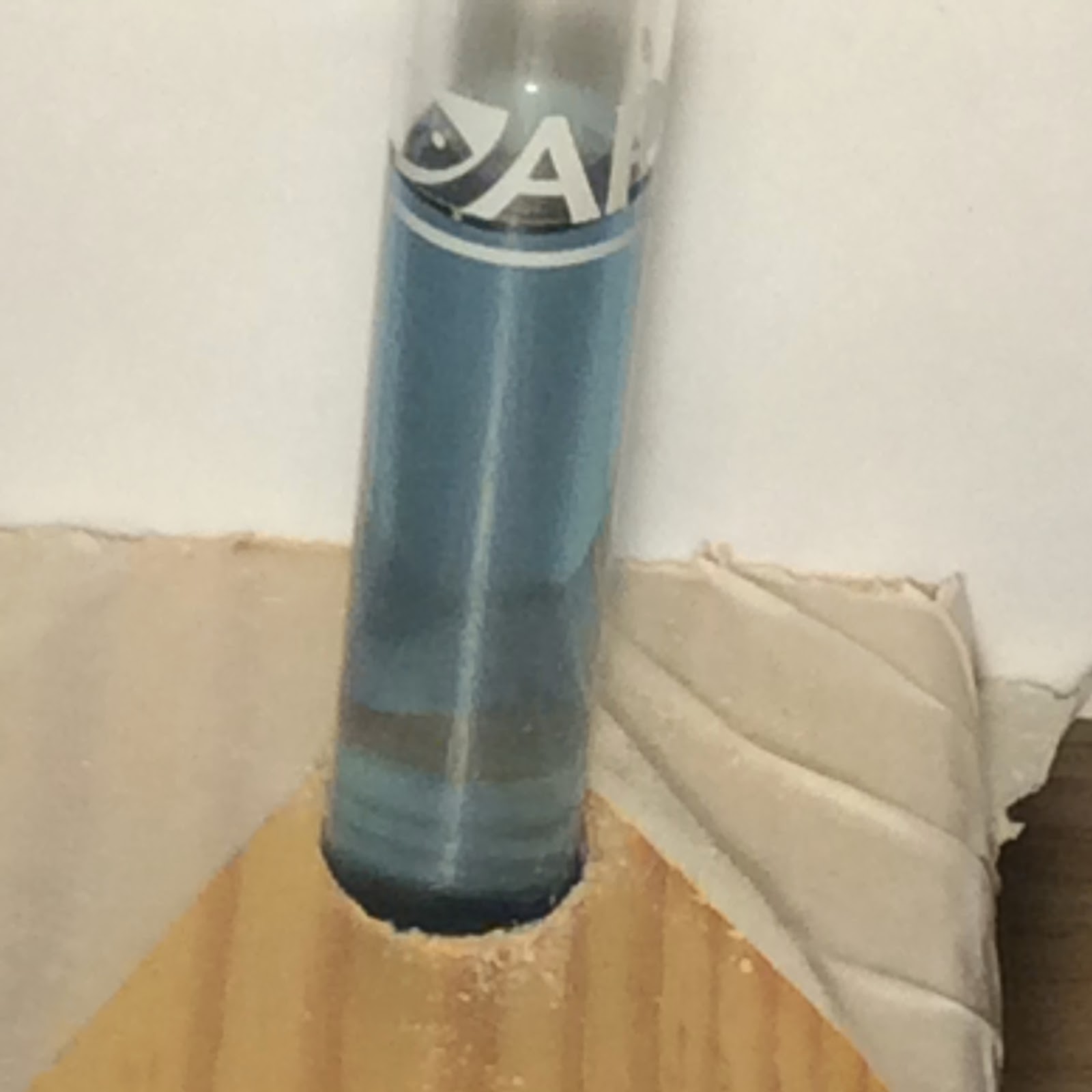
One problem with evaluating the concentration, i that id need to trust that my eyes judge the color intensity reliably and repeatably every day since i dont have a spectrophotometer at home ... After a bit of thinking, i though that since my phone has a camera, it probably could be use in some way as an approximation of a spectrophotometer more reliable than my eyes. I have found that there are apps that give the RGB value of colors in images, and this website : http://www.ourresearch.net/api-test-kit-values.html . Basically, when you enter the RGB value of the given test, it can assign the closest standard from the test kit to it. So now this is how I proceed : I take a picture
, crop the image to have a portion of the tube,
use the app to get the RGB value and go to the website.
The app gives the "dominant" color and a list of other colors present in lower "quantity". I decided to use the 4 most present colors to get a better estimate to the value, and I average it. Sometimes, the website assigns a value that makes no sense to the eye, so I ignore these values. I also made a "device" from a couple of pieces of wood, a desk light, a piece of cardboard and some white paint, to try to control for differences in lighting that most likely would affect the reading.
The device
I set the telephone on the black line.
Its been a few days (4) that i am checking ammonia, nitrite and nitrate (as well as pH). The pH has now stabilized just below 8, the eggsheld have been removed last week. The NH3 seems to progressively increase (most likely, protein from the egg that where disolved gets degraded) from 12 ppm to 18 ppm - but this might be due that my "approximation" of a spectrophotometer is not good enough and that the variation corresponds to lighting differences or that RGB values are not god surrogates for optical densities, or else ... aI will try to see if I could use imageJ, a free software develloped for image analysis and used by countless scientists. Nitrite has made its apparition yesterday, and seem to have increased today. Nitrate are absent.
Aquaponics websites usually say that it take 4 to 6 weeks (or more) before the system is cycled, during this time, nitrite will appear and increase as the first set of bacteria start to work, but then will go back to a low level as the bacteria responsible for the second step (nitrite to nitrate) bloom. They call that the nitrite spike. Then the nitrate level will steadily increase. Once the nitrite is back down to a not detectable level, it is possible to introduce the fish without danger of killing it (or much less).
In conclsion, it seem that my "system" may be starting to cycle, as nitrite has appeared.